The Hype vs Reality
HappyHorse 1.0 vs Seedance 2.0 I tested both AI video models using the same cinematic prompt to see which one actually performs better in real world scenarios.
A new AI video model called HappyHorse 1.0 has been gaining massive attention recently. Some early benchmarks and community discussions suggest that it even outperforms Seedance 2.0 on certain leaderboards.But here’s the real question:
Do benchmark results actually reflect real-world cinematic performance?
To find out, I ran a direct test.
The Controversy Around Happy Horse 1.0
Before diving into the test, it’s important to address a growing debate around HappyHorse 1.0.
If you’ve been active in the AI community, you’ve probably seen claims that the model “isn’t officially released yet” or that many websites offering access to it are just SEO driven wrapper platforms.
Here’s the more accurate picture:
HappyHorse 1.0 does appear to be a real but pseudonymous AI video model that has already surfaced on platforms like Artificial Analysis, where early benchmark results have been observed.
However, its full official release including public model weights, documentation, or a clearly identified developer team is still not available.
Because of this gap, multiple third-party websites have emerged offering access to the model through hosted demos or wrappers. These can be useful for testing outputs, but they shouldn’t be confused with a fully released, open source system.
So while the ecosystem around HappyHorse is still evolving and somewhat fragmented, the outputs generated through these hosted environments provide a practical way to evaluate its current capabilities.
What I Tested (Real Setup)
Instead of relying on generic prompts, I used a highly detailed cinematic prompt designed to stress:
- Camera movement
- Action choreography
- Lighting realism
- Motion consistency
Both models were given the exact same prompt.
The Exact Prompt Used
INT. GRAND FUTURISTIC TECH HALL - NIGHT. ARRI Alexa 65 anamorphic lens captures a brutal Equilibrium-inspired Gun Kata symphony: a lone masculine warrior in flowing black tactical coat dual-wields sleek pistols amid a cavernous minimalist hall of towering sleek metallic walls etched with pulsing holographic grids, vast arched ceiling with harsh converging overhead spotlights carving razor-sharp shadows across polished obsidian floors. Waves of black-clad enemies surge from both ends of the hall, met by his balletic precision – fluid spins, leaps, and dives as he unleashes rapid dual-wield bursts; bullets rip through with hyper-real physics, foes stagger in agony, arterial sprays arc, bodies twist and crumple mid-charge piling in heaps. Camera erupts in visceral sync: extreme Dutch tilts whip through spins, low Dutch angles track falling assailants, frenetic handheld orbits and whip pans chase every shot and stagger, sudden intimate zooms pierce kill shots amid the frenzy – high-contrast chaos in dominant deep cyan cast, cool steel-grey undertones, inky shadows swallowing the fallen, compressed cool highlights, selectively desaturated midtones for moody premium filmic premium, clean fine grain evoking Hollywood mastery. 8K ultra-real, no blur, perfect motion continuity(Full prompt used exactly the same for both models)
Output Comparison
HappyHorse 1.0 Output:
Seedance 2.0 Output:
Key Differences (What Actually Happened)
1. Camera Movement
- Seedance 2.0:
Delivered dynamic, cinematic camera motion with proper tracking, angles, and movement. - HappyHorse 1.0:
Mostly static framing. Complex camera instructions were not followed properly.
2. Action & Motion Consistency
- Seedance:
Smooth choreography, fluid transitions, believable movement. - HappyHorse:
Movement felt stiff and less responsive to the prompt.
3. Cinematic Lighting & Mood
- Seedance:
Strong contrast, proper shadow depth, more “film-like” output. - HappyHorse:
Visually clean, but lacked cinematic depth and mood control.
Where HappyHorse 1.0 Actually Wins
To keep things fair:
- Strong general visuals
- Clean rendering quality
- Good performance on simpler prompts (based on initial testing)
it’s not bad just not consistent under heavy cinematic stress.
The Leaderboard Factor
HappyHorse 1.0 has been reported to perform extremely well on platforms like Artificial Analysis, where models are ranked based on user preference tests.
However, these benchmarks typically:
- Use shorter or simpler prompts
- Focus on general output quality
They don’t always test:
- Complex camera direction
- Multi-subject choreography
- Cinematic sequencing
HappyHorse 1.0 Artificial Analysis Leaderboard:
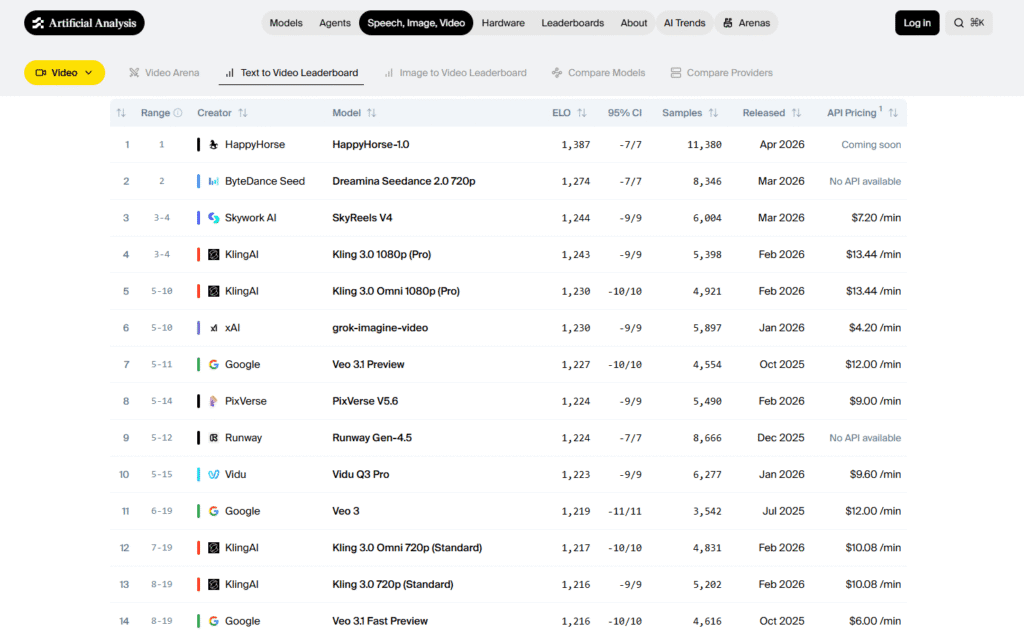
Source: Artificial Analysis Video Arena (Text-to-Video Leaderboard)
Benchmarks vs Real World Testing
This test highlights an important point:
Benchmark performance ≠ real cinematic control
A model can rank highly in general tests but still struggle with:
- detailed filmmaking prompts
- precise camera instructions
- complex motion sequences
Final Verdict
- HappyHorse 1.0:
Interesting and promising, but not fully released yet. Right now, it’s better suited for experimentation rather than serious use. - Seedance 2.0:
Still ahead when it comes to cinematic control, motion, and real-world filmmaking scenarios
Seedance 2.0 remains the more reliable choice still.
My Take as a Creator
From a real world testing perspective:
- Leaderboards are useful
- But they don’t replace actual creative testing
The gap becomes obvious when you push models beyond simple prompts.
Related Read
If you’re exploring more AI tools for video and image generation, check this: Top5 Free AI tools for image and video
Conclusion
HappyHorse 1.0 is definitely worth watching.
But as of now:
Hype doesn’t always match performance.
And in this test
Seedance clearly delivers the more cinematic result.
FAQs
Is HappyHorse 1.0 real or just a scam?
HappyHorse 1.0 appears to be a real AI video model that has already surfaced on platforms like Artificial Analysis. However, its full official release, including public model weights and documentation, is not yet available. Because of this, many third-party websites offering access to it are hosted demos or wrappers, which can create confusion. This does not mean the model itself is fake.
Is HappyHorse 1.0 officially released?
No, HappyHorse 1.0 is not fully released in the traditional sense. There is currently no public GitHub repository, downloadable weights, or official documentation available. Most users are accessing it through hosted demo platforms.
Are HappyHorse websites real or SEO scam sites?
There are multiple websites offering HappyHorse access, and many of them are third-party wrapper platforms. While some may be opportunistic or SEO-driven, not all of them are scams. Some hosted demos do provide real outputs, but users should remain cautious and avoid assuming they represent an official release.
Does HappyHorse 1.0 actually outperform Seedance 2.0?
According to early benchmark platforms like Artificial Analysis, HappyHorse 1.0 has shown strong performance. However, real-world testing with complex cinematic prompts shows that Seedance 2.0 currently delivers more consistent results in areas like camera movement, motion, and cinematic control.